 how-to
How to Jump Start a Car Safely: Step-by-Step Guide
Last Updated: November 8, 2026
Quick Summary
To jump start a car safely, connect the red clamp to the positive terminal of the dead battery, the other red clamp to the positive terminal of the good battery, the black clamp to the negative terminal of the good battery, and the last black clamp to a bare metal grounding point on the dead car's engine block. Disconnect the cables in reverse order once the engine starts.
- Use jumper cables at least 10 feet long with clean clamps, plus safety glasses and gloves.
- Turn off both engines, set the parking brake, and keep the two vehicles from touching.
- Never connect the final negative clamp to the dead battery's negative terminal because of spark risk.
- Drive the car for at least 20 to 30 minutes after a jump to recharge the battery.
- Do not jump-start a battery that is cracked, leaking, swollen, frozen, or smells like rotten eggs.
Table of Contents
- What You Need to Jump Start a Car Safely
- Safety Precautions Before You Connect Cables
- How to Jump-Start a Car with Jumper Cables
- How to Jump-Start a Car with a Battery Pack
- How to Jump-Start a Car Without Cables
- How Long to Run a Car After a Jump-Start
- When Not to Jump-Start a Car and What to Do Instead
- Call for a Professional Jump-Start in Silver Spring
- Frequently Asked Questions
What You Need to Jump Start a Car Safely
A dead battery rarely picks a convenient moment. If you drive in Silver Spring, MD, a cold morning or a forgotten dome light can leave you stranded in a parking garage or on a busy commuter road. This guide walks you through how to jump start a car safely, step by step, whether you carry jumper cables or a portable pack.
Jump-starting a car is the process of using a second power source to send enough current to a weak battery so the engine can turn over and start. Done in the right order, it is quick and low-risk. Done in the wrong order, it can damage electronics or cause a spark near battery gas.
Here is what you need before you open the hood:
- Jumper cables with clean clamps, at least 10 feet long
- A second vehicle with a charged battery, or a portable jump starter
- Safety glasses and work gloves
- A flashlight if you are in a dim garage
- Your owner's manual, which lists the correct jump points for your model
Some newer cars route the positive and negative jump points away from the battery itself, so check the owner's manual before guessing.
Safety Precautions Before You Connect Cables
Before any clamp touches metal, check both batteries for cracks, leaks, or swelling. A damaged battery can rupture or spark. If you see any of that, stop and call for help.
Follow these safety precautions every time:
- Turn off both engines and remove the keys before connecting cables.
- Set the parking brake on both vehicles and put automatic transmissions in Park, manual transmissions in Neutral.
- Turn off the radio, lights, and accessories so nothing draws power during the jump.
- Keep the two vehicles a safe distance apart so they do not touch. Metal-to-metal contact can create a short circuit.
- Remove loose jewelry and keep cable clamps from touching each other.
- Never lean over a battery while connecting or disconnecting clamps.
Watch out: connecting the negative cable to the dead battery's negative terminal can cause a spark near hydrogen gas. Always use a grounding point on the engine block instead.
How to Jump-Start a Car with Jumper Cables
Here is the core skill most drivers need: how to jump-start a car with jumper cables in the correct connection order. The order matters more than the speed, because each clamp you place changes where a spark could land.
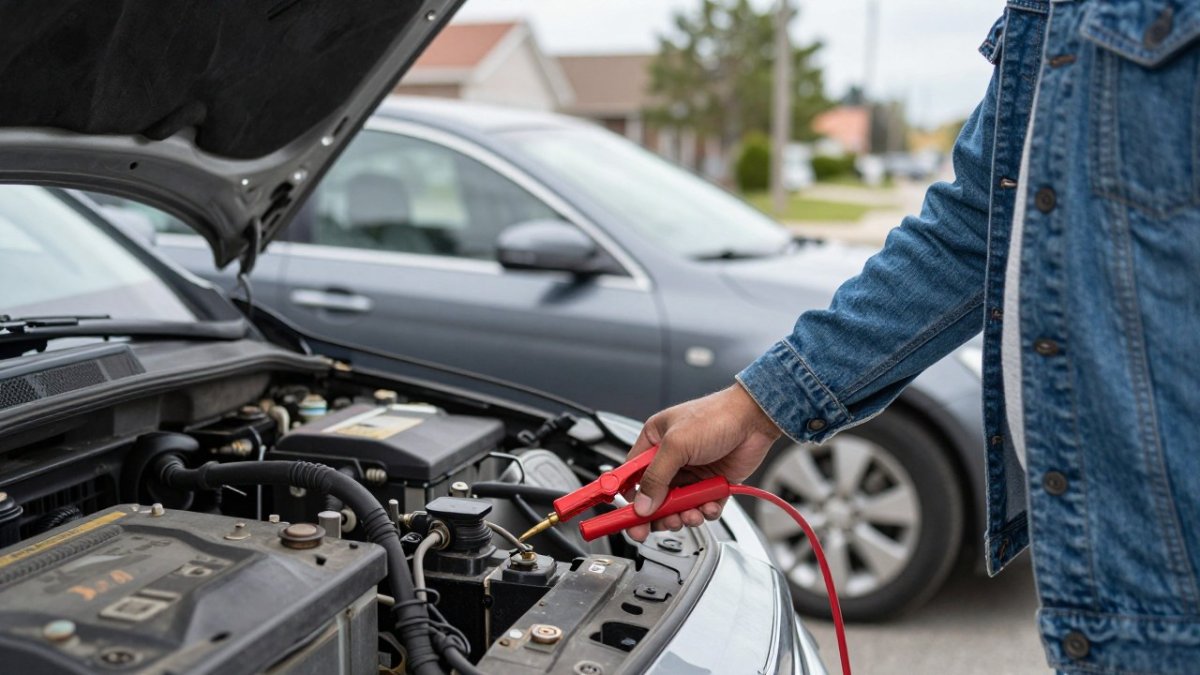
Positioning the Vehicles and Turning Off the Ignition
Park the donor vehicle close enough that the cables reach with slack, but do not let the bumpers touch. Metal-to-metal contact between the two cars can create a short circuit through the bodies. Turn off the ignition in both cars and remove the keys. Set the parking brake and confirm Park on automatics or Neutral on manuals. Pop both hoods and secure them with the prop rod so they cannot fall while you work.
Locating the Battery and Identifying the Terminals
Find the battery, which may sit under a plastic cover held by clips or a single bolt. Look for the positive terminal, usually marked with a plus sign and often a red cap or red cable. The negative terminal is marked with a minus sign and a black cable. If the terminals are corroded, brush them clean with a terminal brush or a stiff wire brush before attaching anything, corrosion adds resistance and can keep the jump from working even with a good battery.
On many newer vehicles, the battery is in the trunk or under the rear seat, and the manufacturer provides remote jump points under the hood: a red positive post and a designated negative ground stud. Use those points exactly as the owner's manual shows. Clamping to the wrong stud can back-feed electronics.
Connecting the Cables in the Correct Order
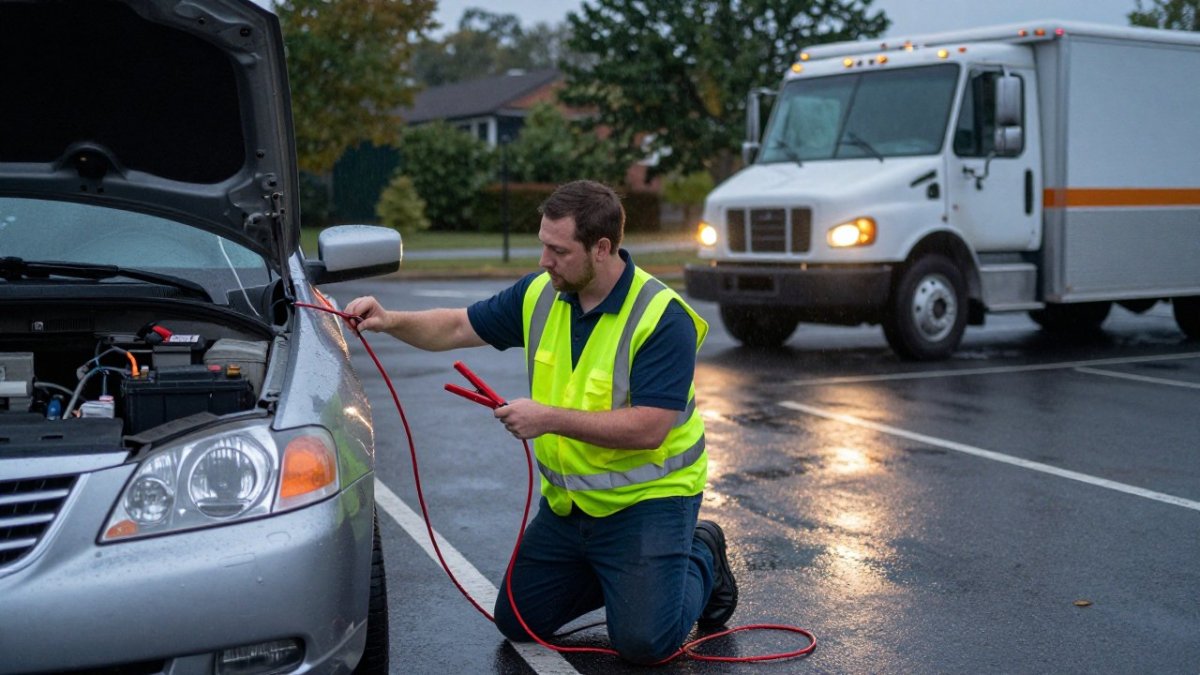
Connect the clamps in this exact sequence:
- Red clamp to the positive terminal of the dead battery.
- Red clamp on the other end to the positive terminal of the good battery.
- Black clamp to the negative terminal of the good battery.
- Black clamp to a bare metal grounding point on the dead car's engine block, away from the battery.
A good grounding point is an unpainted engine bracket, a lifting eye, or a bolt on the engine block itself. Avoid the negative terminal of the dead battery, fuel lines, brake lines, and any painted surface. The reason for the last clamp on bare metal is that the final connection is where a small spark is most likely, and you want that spark far from the hydrogen gas a battery can vent.
Watch out: if a clamp slips and touches the other cable's clamp while the circuit is live, you can short the battery and damage the cables or the vehicle. Keep the free clamps apart and never let them touch each other.
Start the donor car and let it run a minute or two so its alternator can stabilize. Then try the dead car. If it starts, leave both running briefly, then disconnect in reverse order: negative ground clamp first, then the black clamp on the good battery, then the red clamp on the good battery, then the red clamp on the dead battery.
Connect the clamps in this exact sequence, then disconnect in reverse order.
| Step | Clamp | Connect to |
|---|---|---|
| 1 | Red | Positive terminal of the dead battery |
| 2 | Red | Positive terminal of the good battery |
| 3 | Black | Negative terminal of the good battery |
| 4 | Black | Bare metal grounding point on dead car's engine block |
How to Jump-Start a Car with a Battery Pack
A portable jump starter removes the need for a second vehicle. It is the better option in a crowded garage or when you are alone. Here is how to jump-start a car with a battery pack:
- Charge the pack and check its indicator before you store it.
- Connect the red clamp to the positive terminal, black to a ground point.
- Turn the pack on and wait for the ready light.
- Crank the engine. Most packs start a car on the first try.
- Disconnect in reverse and recharge the pack afterward.
Keep the pack in your trunk.
How to Jump-Start a Car Without Cables
You can jump-start a car without cables only if you have another power source, such as a portable jump starter or a jump box. There is no safe way to jump a car with bare wires or by pushing an automatic. Pushing works only on a manual transmission, and it strains the clutch.
If you have neither cables nor a pack, your realistic options are calling a friend with cables or calling roadside help. Do not improvise with household wire. It cannot carry the current and can melt or spark.
How Long to Run a Car After a Jump-Start
Drive the car for at least 20 to 30 minutes after a jump, and longer if you can. The alternator recharges the battery as the engine runs, so idling in park is far less effective than driving. How long to run a car after a jump-start depends on battery condition and how deeply it drained.
To confirm the battery is charging, watch for these signs:
- The battery light stays off after startup
- Headlights stay bright at idle
- The car restarts cleanly after you shut it off
If the car dies again soon after, the battery may be failing or the alternator may be weak. A load test at a shop will tell you which.
When Not to Jump-Start a Car and What to Do Instead
Some situations call for professional help, not cables. The warning signs below are the ones most drivers miss, and each one points to a specific risk rather than a vague caution.
Do not jump-start if the battery is physically damaged. A cracked case, leaking electrolyte, a swollen or bulging side, or a battery that is frozen solid can rupture or spark when current hits it.
Do not jump-start a car with a fuel leak or a strong gas smell. A spark near fuel is a fire risk. Shut it down, move away, and call for help.
Modern vehicles, hybrids, and EVs need extra care. Many hybrids and EVs have specific jump points under the hood and a high-voltage traction system you should never touch.
Check the owner's manual before you clamp anything. It lists terminal locations, the approved grounding point, and any model-specific restrictions. Guessing on a modern car can cost more than the tow.
If a jump fails, work through the likely causes before you try again.
If you are stranded in traffic, on a highway shoulder, or in a tight parking garage, moving the car safely matters more than a quick fix. You can read about what to expect from emergency towing services near you before you call, and understand why 24-hour towing keeps stranded drivers safe when you are stuck after dark.
Call for a Professional Jump-Start in Silver Spring
If the jump does not work, or you would rather not handle it yourself, Carlito's Towing Services provides 24/7 roadside assistance across the Metro DC area, including Silver Spring, Beltsville, Laurel, and Rockville.
You can find our location and contact details to reach us directly.
Stranded with a dead battery and no one to call? Carlito's Towing Services offers 24/7 roadside assistance, fast response times, and affordable pricing across the Metro DC area. Get started with Carlito's Towing Services and get back on the road safely.
Frequently Asked Questions
What is the proper order for connecting jumper cables?
Connect the red clamp to the dead battery's positive terminal first, then the red clamp to the donor battery's positive terminal. Next, attach the black clamp to the donor battery's negative terminal, and finally clip the last black clamp to a bare metal grounding point on the dead car's engine block, away from the battery. This order lowers the risk of a spark near battery gases and keeps the electrical path predictable. Reverse the sequence when disconnecting.
Can a battery be too dead to jump-start?
Yes. If the battery is deeply discharged, has a broken internal connection, or shows visible damage like swelling or cracks, a jump may not help and can be unsafe. Corroded or loose terminals also block current flow. In those cases, the battery likely needs replacement rather than another jump. If the engine turns over slowly or not at all after a proper connection, stop trying and have the battery tested.
Can you jump-start a car with a portable battery pack?
Yes. A portable jump starter connects directly to the battery terminals and does not need a second vehicle. Clamp the red lead to the positive terminal and the black lead to a ground point or the negative terminal per the pack's instructions, then start the car. Battery packs are especially useful in parking garages or tight spots where positioning a donor car is difficult. Keep the pack charged and check its capacity before relying on it.
What should you do if the car still will not start after a jump?
If the engine does not start after a proper jump attempt, stop and check the connections for corrosion or looseness. A failed jump can point to a dead battery, a faulty starter, or an alternator problem. Repeated attempts can damage electronics, so avoid cranking indefinitely. In Silver Spring and the Metro DC area, Carlito's Towing Services offers 24/7 roadside assistance.